

Explaining a "Clean" Continuing Resolution
Understanding what Congress is really voting on, and what it means for health care, budgets, and you

Let’s start simple: What’s a Continuing Resolution?
A Continuing Resolution (CR) is Congress’s version of a “temporary budget extension.”
When the fiscal year ends on September 30 and lawmakers haven’t passed all twelve spending bills, they pass a CR to keep the government open.
Think of it like paying the bills with last year’s checkbook until a new one arrives. It’s supposed to be short-term, just to prevent a shutdown.
In a normal year:
Congress passes a budget resolution that sets overall spending targets.
Then 12 separate appropriations bills fund agencies like Defense, Transportation, and Health & Human Services.
If they run out of time, a CR continues last year’s funding (with a few small tweaks) until the new bills are ready.
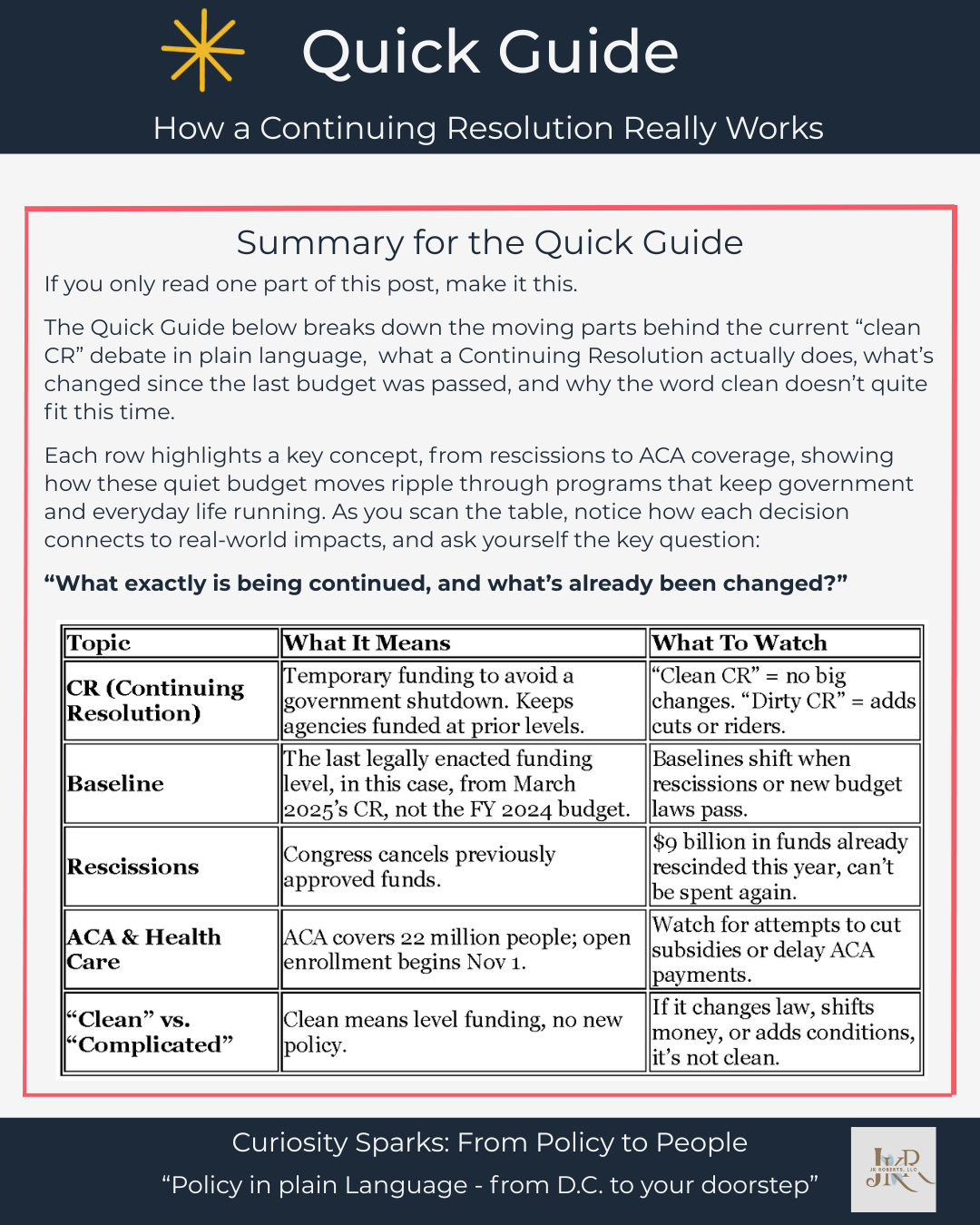
That’s what most people mean by a “clean CR,” one that simply extends existing funding, without adding or cutting anything major.
But here’s the catch: this year’s CR isn’t “clean.”
When politicians call this a “clean” CR, they’re skipping an important detail:
the baseline they’re continuing has already changed.
Here’s why:
1️⃣ The last budget law wasn’t the original FY 2024 budget.
The government has been operating under the Full-Year Continuing Appropriations and Extensions Act, 2025 since March.
That act already included adjustments:
Small cuts to non-defense programs.
Slight increases for defense and disaster relief.
A few policy extensions (like nutrition and infrastructure programs).
So, even if Congress says this new CR “keeps things the same,” it’s actually keeping things the same as of March 2025, not the full 2024 budget.
2️⃣ Congress passed a Rescissions Act this summer.
That law canceled $9 billion in previously approved funds, mostly unspent dollars from international aid, public broadcasting, and some domestic programs.
Once a rescission passes, those funds are gone.
So, a “clean CR” can’t restore them unless Congress explicitly adds them back, which would make it not clean.
3️⃣ New budget laws already changed the math.
Since March, Congress passed other budget actions, including changes in how the federal government pays for health care (under the ACA), veterans’ services, and energy programs.
That means we’re no longer continuing the same budget picture from last year.
The numbers have moved.
So, when someone says, “this is just a clean CR,” what they’re really saying is,
“We’re continuing the current spending plan, which has already been revised
several times.”
How the Affordable Care Act fits into this moment
Let’s talk about something concrete that affects real people: health insurance.
The Affordable Care Act (ACA), sometimes called “Obamacare,” provides marketplace coverage for over 22 million Americans.
Open Enrollment starts November 1
Each year, millions of people shop for coverage through Healthcare.gov and state exchanges.
This year’s open enrollment starts November 1, 2025, not December 31.
That’s when:
People can renew or change plans,
New enrollees can sign up, and
Premium subsidies (the financial help that makes coverage affordable) kick in for the next year.
Budget laws and the ACA
In July 2025, Congress passed a budget reconciliation bill that changed some ACA rules, adjusting premium subsidies, eligibility, and Medicaid transition rules.
Those changes are already law.
So, any CR that passes now does not override those updates.
It simply keeps the lights on for the agencies that administer them, mainly the Department of Health and Human Services and Centers for Medicare & Medicaid Services (CMS).
If the CR were truly “clean,” it would maintain those updated programs exactly as written. But if lawmakers try to use the CR to change ACA funding (as some have hinted), it becomes a policy vehicle, not a clean extension.
Why this matters to you
If Congress doesn’t pass a CR by the deadline, the government partially shuts down, meaning federal employees go unpaid, national parks close, and funding for programs like SNAP, WIC, and FEMA operations may slow.
If Congress passes a “clean” CR, it keeps things running smoothly while they negotiate the full budget, ideally through the normal appropriations process.
But if they pass a CR that quietly changes funding, adds policy riders, or tries to relitigate past battles (like the ACA), it’s not clean.
It’s just a temporary fight dressed up as a fix.
Why you should care right now
Open enrollment begins Nov 1. If you or someone you know relies on ACA coverage, set a reminder. Even if Congress stalls, those benefits and subsidies continue, because they’re part of existing law.
A CR doesn’t decide new benefits, but it can delay updates. Programs that need new funding or expansions (like community health grants or rural hospital support) can’t start until a full budget passes.
Shutdowns cost more than they save. Every week of delay costs billions in lost productivity and back pay, for what’s often a political talking point.
The Takeaway
A Continuing Resolution is supposed to be a bridge, not a battlefield.
But calling this one “clean” is misleading. The budget has already changed.
Rescissions have been enacted. New health care rules are live.
The cleanest path forward would be for Congress to pass a short-term CR that truly just extends operations, no gimmicks, no policy riders, and then do the work of negotiating a real, transparent budget.
Curiosity Spark:
If you hear “clean CR” on the news this week, pause and ask:
“Which baseline are they continuing, and what changed since then?”
That question alone makes you more informed than most people in Washington.